
- 분류 전체보기 (1058)

- Linguistics (고급 영어학) (10)
- Stylistics (6)
- Etymology & Word Building (15)
- Philosophy Meets Grammar (6)
- Collection of Famous Quotes (22)
- English Mechanism (276)
- The Language Beyond Grammar (279)
- Living English (81)
- Miso’s Life Notes (18)
- My English Journey and Refl.. (16)
- Philosophy (132)
- Video Clip (16)
- Airline English (항공 영어) (47)
- Creative Corner (35)
- Sally & Sia (1)
| 일 | 월 | 화 | 수 | 목 | 금 | 토 |
|---|---|---|---|---|---|---|
| 1 | 2 | 3 | 4 | |||
| 5 | 6 | 7 | 8 | 9 | 10 | 11 |
| 12 | 13 | 14 | 15 | 16 | 17 | 18 |
| 19 | 20 | 21 | 22 | 23 | 24 | 25 |
| 26 | 27 | 28 | 29 | 30 |
- MisoEnglish#불교철학 #BuddhismPhilosophy #사성제 #FourNobleTruths #공사상 #Emptiness #명상 #Mindfulness #열반 #EasternWisdom
- pnr
- 영국사 #영국역사 #세계사 #역사연재 #브리튼에서영국까지
- MisoEnglish#철학입문 #Philosophy #종교철학 #PhilosophyOfReligion #철학공부 #신존재증명 #악의문제 #PhilosophyForBeginners #교육콘텐츠 #철학시리즈
- English in English
- MisoEnglish#철학입문 #Philosophy #정치철학 #PoliticalPhilosophy #철학공부 #정의론 #자유주의 #PhilosophyForBeginners #교육콘텐츠 #철학시리즈
- 영문법
- MisoEnglish#한국철학 #KoreanPhilosophy #홍익인간 #Hongik #화랑도 #Hwarang #단군 #Dangun #풍류도 #ThreeKingdoms#동양철학
- 영어공부
- MisoEnglish#도교철학 #Taoism #도덕경 #TaoTeChing #무위자연 #WuWei #노자 #Laozi #장자 #YinYang
- English Speaking Practice
- Basic English Verbs
- MisoEnglish#철학입문 #Philosophy #과학철학 #PhilosophyOfScience #철학공부 #포퓨퍼 #쿠hn #과학방법론 #교육콘텐츠 #철학시리즈
- MisoEnglish#철학입문 #Philosophy #형이상학 #Metaphysics #철학공부 #존재론 #실재론 #PhilosophyForBeginners #교육콘텐츠 #철학시리즈
- misoenglish
- MisoEnglish#철학입문 #Philosophy #심리철학 #PhilosophyOfMind #철학공부 #의식 #마음 #PhilosophyForBeginners #교육콘텐츠 #철학시리즈
- 영어회화
- 감성영어
- 🌿 English with Heart
- everyday English
- 영어문법
- MisoEnglish#철학입문 #Philosophy #윤리학 #Ethics #도덕철학 #철학공부 #칸트 #공리주의 #교육콘텐츠 #철학시리즈
- 인도철학 #동양철학 #인문학 #요가 #명상 #힌두교 #불교 #간디 #타고르 #정통6파 #철학공부 #마음공부 #MisoEnglish #인문학영어
- 동양정치철학 #시리즈완결 #아시아적가치 #동서양비교 #유교 #민주주의 #정치사상 #인문학 #비교철학 #글로벌정치 #문화다양성 #2500년철학사
- AirlineOpsEnglish
- ticketing
- 영어접속사
- EnglishWriting #AcademicWriting #Grammar #EnglishLanguage #EssayWriting #ParagraphStructure #SentenceStructure #BusinessEnglish #EnglishTips #WritingSkills #Linguistics #ESL
- English for Korean Learners
- MisoEnglish#유교철학 #Confucianism #성리학 #NeoConfucianism #인의예지 #Virtue #맹자 #Mencius #실학 #KoreanScholarship
- Today
- Total
MisoEnglish
현대 영어의 축약과 생략 패턴 완벽 가이드 본문
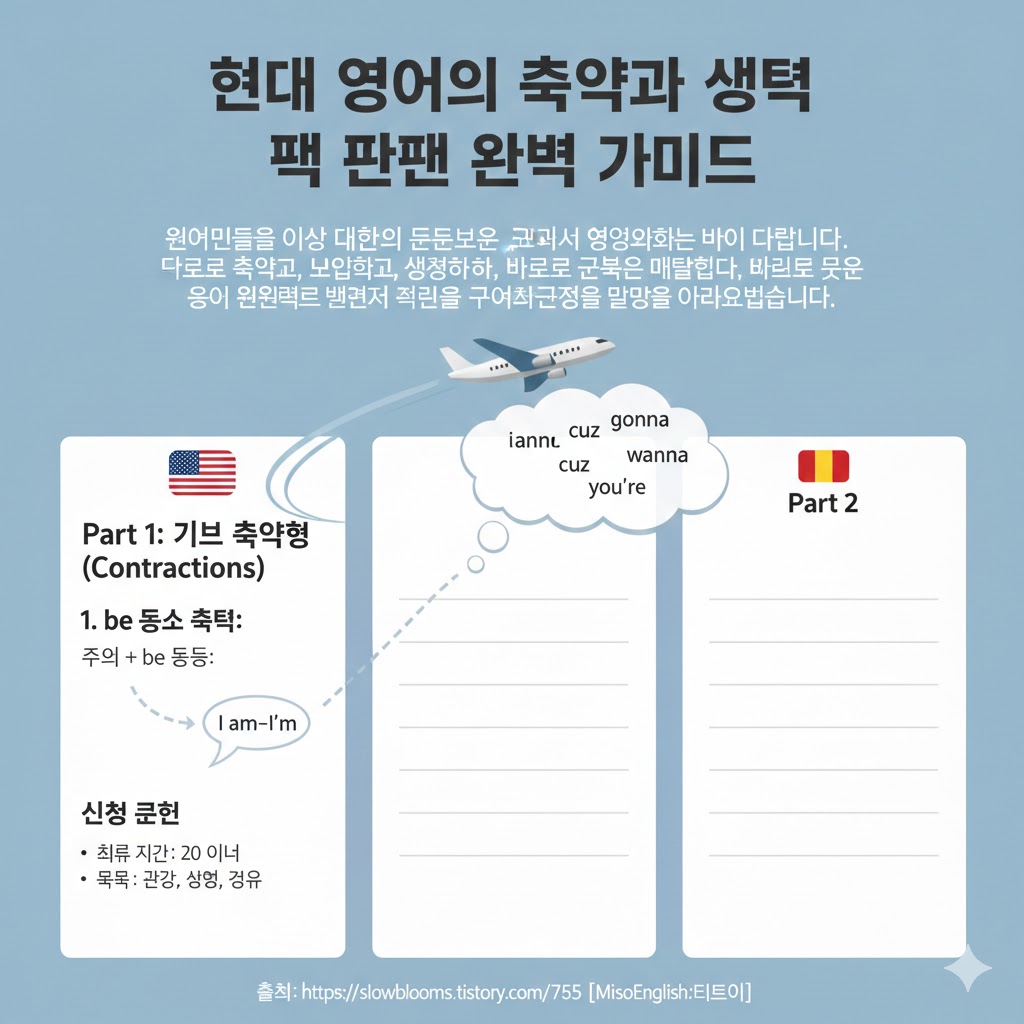
현대 영어의 축약과 생략 패턴 완벽 가이드
원어민들의 일상 대화를 들어보면 교과서 영어와는 많이 다릅니다. 단어를 축약하고, 불필요한 부분을 생략하며, 빠르고 자연스럽게 말합니다. 오늘은 현대 영어에서 자주 사용되는 축약과 생략 패턴들을 배워서 진짜 원어민처럼 자연스러운 구어체를 구사하는 방법을 알아보겠습니다.
Part 1: 기본 축약형 (Contractions)
1. be 동사 축약
주어 + be 동사:
- I am → I'm
- You are → You're
- He is → He's
- She is → She's
- It is → It's
- We are → We're
- They are → They're
부정형:
- is not → isn't
- are not → aren't
- was not → wasn't
- were not → weren't
예문:
- "I'm tired." (나 피곤해)
- "She's amazing." (그녀 대단해)
- "They're coming." (그들이 오고 있어)
- "It isn't fair." (공평하지 않아)
2. have 동사 축약
현재완료:
- I have → I've
- You have → You've
- He has → He's (주의: He is와 같은 형태!)
- She has → She's
- We have → We've
- They have → They've
부정형:
- have not → haven't
- has not → hasn't
- had not → hadn't
예문:
- "I've been there." (거기 가봤어)
- "She's finished." (그녀가 끝냈어)
- "We've got a problem." (문제가 생겼어)
- "Haven't seen you in a while!" (오랜만이야!)
3. will/would 축약
will:
- I will → I'll
- You will → You'll
- He will → He'll
- She will → She'll
- We will → We'll
- They will → They'll
would:
- I would → I'd
- You would → You'd
- He would → He'd
- We would → We'd
부정형:
- will not → won't (불규칙!)
- would not → wouldn't
예문:
- "I'll call you." (전화할게)
- "She'll be here soon." (곧 올 거야)
- "I'd love to!" (좋아!)
- "Won't be long." (오래 안 걸려)
4. 조동사 부정 축약
- cannot → can't
- could not → couldn't
- should not → shouldn't
- must not → mustn't
- might not → mightn't (덜 흔함)
- need not → needn't (주로 영국)
예문:
- "I can't believe it!" (믿을 수 없어!)
- "You shouldn't do that." (그러면 안 돼)
- "We couldn't find it." (찾을 수 없었어)
5. 이중 축약 (Double Contractions)
구어체에서는 이중 축약도 흔합니다.
- could not have → couldn't've
- should not have → shouldn't've
- would not have → wouldn't've
- might not have → mightn't've
- must not have → mustn't've
예문:
- "I couldn't've done it without you." (너 없이는 못 했을 거야)
- "You shouldn't've said that." (그렇게 말하면 안 됐어)
Part 2: 주어 생략 (Subject Omission)
1. 일상 대화에서 주어 생략
구어체에서는 맥락이 명확하면 주어를 자주 생략합니다.
I 생략:
- (I) Don't know. → Don't know.
- (I) Can't believe it. → Can't believe it.
- (I) Told you so. → Told you so.
- (I) Got it. → Got it.
- (I) See what you mean. → See what you mean.
- (I) Forgot. → Forgot.
- (I) Love it! → Love it!
You 생략:
- (You) Want some coffee? → Want some coffee?
- (You) Coming? → Coming?
- (You) Ready? → Ready?
- (You) Hear me? → Hear me?
- (You) Serious? → Serious?
It 생략:
- (It) Doesn't matter. → Doesn't matter.
- (It) Looks good. → Looks good.
- (It) Sounds great. → Sounds great.
예문 대화:
- "Want to grab lunch?" (점심 먹을래?)
- "Sounds good!" (좋아!)
- "Can't believe it's already Friday." (벌써 금요일이라니 믿기지 않아)
- "Told you it would work!" (될 거라고 했잖아!)
2. 명령문에서의 생략
명령문은 원래 주어(You)가 생략됩니다.
예문:
- (You) Come here. → Come here.
- (You) Listen to me. → Listen to me.
- (You) Wait a minute. → Wait a minute.
- (You) Take care. → Take care.
Part 3: be 동사 생략
1. 질문에서 be 동사 생략
축약형:
- Are you ready? → You ready?
- Are you serious? → You serious?
- Are you kidding? → You kidding?
- Is he coming? → He coming?
- Are they here? → They here?
예문:
- "You okay?" (괜찮아?)
- "She here yet?" (그녀 왔어?)
- "You sure?" (확실해?)
- "He crazy?" (그 사람 미쳤어?)
2. 진술문에서 be 동사 생략
예문:
- (I'm) Sorry. → Sorry.
- (I'm) Not sure. → Not sure.
- (It's) Good to see you. → Good to see you.
- (That's) Too bad. → Too bad.
- (I'm) Just saying. → Just saying.
Part 4: 관사 생략 (Article Omission)
1. 일상 대화에서 관사 생략
the 생략:
- Go to (the) store. → Go to store.
- At (the) office → At office
- In (the) morning → In morning
- See you at (the) gym → See you at gym
a/an 생략:
- Got (a) minute? → Got minute?
- Need (a) favor. → Need favor.
- Want (a) drink? → Want drink?
예문:
- "Going to store. Need anything?" (가게 가는데 필요한 거 있어?)
- "See you at office." (사무실에서 봐)
2. 특정 표현에서 관사 생략
교통수단:
- by (the) car → by car
- on (the) bus → on bus (구어)
- by (the) train → by train
장소:
- at home (the 없음)
- at work (the 없음)
- in bed (the 없음)
- at school (the 없음)
Part 5: 조동사 생략
1. have/has 생략
현재완료:
- (I've) Got to go. → Gotta go.
- (I've) Been there. → Been there.
- (You've) Done it before. → Done it before.
2. will 생략
예문:
- (I'll) See you later. → See you later.
- (I'll) Talk to you soon. → Talk to you soon.
- (I'll) Be right back. → Be right back.
3. do/does 생략
부정 의문문:
- (Do you) Want some? → Want some?
- (Does it) Make sense? → Make sense?
Part 6: 전치사 생략
1. 시간 표현
- (on) Monday → Monday
- (on) Friday night → Friday night
- (in the) next week → next week
- (at) what time → what time
예문:
- "See you Monday!" (월요일에 봐!)
- "Let's meet Friday night." (금요일 밤에 만나자)
2. 장소 표현
- (at) home → home
- Come (to) here → Come here
- Go (to) there → Go there
Part 7: 초단축형 (Super Contractions)
1. gonna (going to)
미래 계획:
- I'm going to → I'm gonna / gonna
- "I'm gonna go." (갈 거야)
- "Gonna be late." (늦을 것 같아)
- "What are you gonna do?" (뭘 할 거야?)
2. wanna (want to)
원함:
- I want to → I wanna
- Do you want to → You wanna / Wanna
- "I wanna go home." (집에 가고 싶어)
- "Wanna grab coffee?" (커피 마실래?)
- "Don't wanna talk about it." (얘기하고 싶지 않아)
3. gotta (got to / have got to)
필요, 의무:
- I've got to → I gotta / Gotta
- "I gotta go." (가야 해)
- "Gotta finish this." (이거 끝내야 해)
- "You gotta see this!" (이거 봐야 해!)
4. kinda / sorta (kind of / sort of)
다소, 약간:
- kind of → kinda
- sort of → sorta
- "It's kinda cold." (좀 추워)
- "I'm sorta busy." (좀 바빠)
- "That's kinda weird." (그거 좀 이상해)
5. outta (out of)
~에서 나가:
- out of → outta
- "Get outta here!" (여기서 나가!)
- "I'm outta time." (시간이 없어)
- "We're outta milk." (우유가 떨어졌어)
6. gimme (give me)
줘:
- give me → gimme
- "Gimme a break!" (좀 봐줘!)
- "Gimme a minute." (1분만 줘)
- "Gimme that!" (그거 내게 줘!)
7. lemme (let me)
~하게 해줘:
- let me → lemme
- "Lemme see." (내가 좀 볼게)
- "Lemme know." (알려줘)
- "Lemme think." (생각 좀 해볼게)
8. dunno (don't know)
모르겠어:
- I don't know → I dunno / dunno
- "I dunno what to do." (뭘 해야 할지 모르겠어)
- "Dunno." (몰라)
- "Who knows? I dunno." (누가 알겠어? 난 몰라)
9. shoulda / coulda / woulda
과거 가정:
- should have → shoulda
- could have → coulda
- would have → woulda
- "I shoulda known." (알았어야 했는데)
- "You coulda told me." (말해줄 수도 있었잖아)
- "That woulda been great." (그랬으면 좋았을 텐데)
10. ain't (비표준이지만 흔함)
am not / is not / are not / have not / has not:
- "I ain't going." (안 갈 거야)
- "That ain't right." (그건 옳지 않아)
- "Ain't nobody got time for that!" (아무도 그럴 시간 없어!)
주의: 비격식적, 일부 방언에서 흔함
Part 8: 질문 형식 간소화
1. 의문사 + 주어 + 동사 → 의문사만
예문:
- What is that? → What's that? → What that?
- Where are you going? → Where you going? → Where going?
- How are you doing? → How you doing? → How doing?
2. 짧은 응답 질문
Tag Questions 생략형:
- It's nice, isn't it? → Nice, right?
- You know what I mean? → You know? / Y'know?
- Don't you think? → Right?
예문:
- "That was fun, right?" (재미있었지, 그치?)
- "Pretty cool, huh?" (꽤 멋지지, 응?)
- "Good idea, yeah?" (좋은 생각이지, 응?)
Part 9: 응답 축약
1. 긍정 응답
예문:
- Yes, I do. → Yeah. / Yep. / Uh-huh.
- Yes, I am. → Yep.
- Yes, I will. → Sure.
- I agree. → Totally. / For sure. / Absolutely.
2. 부정 응답
예문:
- No, I don't. → Nope. / Nah. / Uh-uh.
- No, I'm not. → Nope.
- I don't think so. → Don't think so. / Nah.
3. 초간단 응답
- "Got it." (알았어)
- "Sure thing." (물론이지)
- "No problem." (문제없어)
- "My bad." (내 실수)
- "Fair enough." (일리 있어)
- "Works for me." (나는 괜찮아)
Part 10: 문장 전체 축약
1. 인사 표현
정식:
- How are you doing? → How're you doing? → How you doing? → How's it going? → Howdy!
- What is up? → What's up? → 'Sup?
- How do you do? → How do? (고어적)
2. 일상 표현
예문:
- I don't care. → Don't care. → Whatever.
- I don't know. → Don't know. → Dunno. → I'unno.
- Let me see. → Lemme see.
- Give me a break. → Gimme a break.
- I have got to go. → I've gotta go. → Gotta go.
3. 감사/사과
예문:
- Thank you. → Thanks. → Thx.
- I am sorry. → I'm sorry. → Sorry.
- Excuse me. → 'Scuse me.
Part 11: 문자/채팅 축약 (Text Speak)
1. 일반 축약
- You → U
- Are → R
- See → C
- Before → B4
- For → 4
- To/Too → 2
- Great → Gr8
- Later → L8r
2. 구문 축약
- I don't know → IDK
- In my opinion → IMO
- To be honest → TBH
- By the way → BTW
- For your information → FYI
- Laughing out loud → LOL
- Oh my god → OMG
- Talk to you later → TTYL
- Be right back → BRB
예문:
- "IDK what to do TBH." (솔직히 뭘 해야 할지 모르겠어)
- "BTW, see you L8r!" (근데, 나중에 봐!)
Part 12: 발음 축약 (Reduced Speech)
1. 약화된 발음 (실제 발음)
to:
- going to → /gənə/ → gonna
- want to → /wɑnə/ → wanna
- got to → /gɑɾə/ → gotta
- have to → /hæftə/ → hafta
- ought to → /ɔːɾə/ → oughta
2. and의 축약
- and → 'n / n'
- "Rock 'n' roll" (로큰롤)
- "Fish 'n' chips" (피시 앤 칩스)
- "Mac 'n' cheese" (맥 앤 치즈)
3. of의 축약
- a lot of → a lotta
- kind of → kinda
- sort of → sorta
- out of → outta
- couple of → coupla
4. you의 축약
- Did you → Didja / D'you
- Would you → Wouldja
- Could you → Couldja
- Don't you → Doncha
- What do you → Whatcha / Whatchu
- What are you → Whatcha
예문:
- "Whatcha doing?" (뭐 해?)
- "Didja see that?" (그거 봤어?)
- "Doncha think?" (그렇게 생각 안 해?)
실전 활용 가이드
상황별 사용
친구와의 일상 대화 - 자유롭게 사용
- "Wanna grab lunch?"
- "Gotta go, see ya!"
- "Dunno, lemme think."
직장 동료 - 적당히 사용
- "I'm gonna finish this soon."
- "Can't make it today."
- "Sounds good!"
격식있는 상황 - 최소한만
- "I'll call you later." (I will)
- "We're ready." (We are)
- 초단축형은 피하기
문자/이메일 - 관계에 따라
- 친구: 자유롭게
- 동료: 적당히
- 상사/고객: 최소한
주의사항
절대 쓰면 안 되는 상황:
- 공식 문서, 학술 논문
- ❌ "We're gonna analyze..."
- ✓ "We are going to analyze..."
- 면접, 프레젠테이션
- ❌ "I wanna work here..."
- ✓ "I want to work here..."
- 처음 만난 사람과의 격식있는 대화
- ❌ "Nice to meetcha!"
- ✓ "Nice to meet you."
안전한 축약:
- 기본 축약형 (I'm, you're, don't 등)은 대부분 상황에서 OK
- gonna, wanna, gotta는 친한 사람과만
- ain't, dunno 등은 매우 캐주얼한 상황에서만
연습 팁
1. 듣기 연습
영화/드라마:
- 자막 없이 들으면서 축약형 익히기
- 같은 장면을 반복해서 듣기
팟캐스트:
- 일상 대화 스타일 팟캐스트 듣기
- 원어민의 자연스러운 축약 패턴 파악
2. 말하기 연습
혼자 연습:
- 일상 문장을 축약형으로 바꿔 말하기
- "I am going to go" → "I'm gonna go"
실전 연습:
- 친한 원어민 친구와 대화
- 온라인 언어 교환
3. 단계별 학습
초급: 기본 축약부터
- I'm, you're, don't, can't
중급: 초단축형 추가
- gonna, wanna, gotta
고급: 자연스러운 생략
- 주어 생략, be동사 생략
마무리
현대 영어의 축약과 생략은 단순히 '게으른' 말하기가 아니라, 자연스럽고 효율적인 의사소통의 핵심입니다.
핵심 정리:
- 기본 축약형은 대부분 상황에서 사용 가능
- 초단축형(gonna, wanna 등)은 캐주얼한 상황에서
- 주어/be동사 생략은 맥락이 명확할 때
- 상황 파악이 가장 중요 - 격식에 맞게 조절
- 듣기부터 시작 - 원어민의 패턴 익히기
처음에는 듣기와 이해에 집중하고, 점차 말하기에 적용해보세요. 자연스러운 영어는 완벽한 문법보다 효과적인 의사소통에서 나옵니다.
기억하세요: 축약과 생략은 편의를 위한 것이지, 항상 써야 하는 것은 아닙니다. 상황과 대화 상대에 맞춰 적절히 사용하는 것이 진짜 영어 실력입니다!
이제 "Gonna make you sound like a native speaker!" 😉
[ MisoEnglish 저작권 안내 ] 본 블로그의 모든 게시물은 저작권법의 보호를 받으며, 무단 도용 및 배포 시 사전 고지 없이 법적 조치를 취할 수 있습니다. All posts are protected under copyright law. Unauthorized use may result in legal action.
Copyright 2026. MisoEnglish. All rights reserved.
'English Mechanism' 카테고리의 다른 글
| 전치사 활용의 모든 것 완벽 가이드 (1) | 2026.01.16 |
|---|---|
| 부정문을 긍정으로 바꾸는 기술 완벽 가이드 (0) | 2026.01.16 |
| '겉으로 보기에는' (On the face of it) 외 고급 어휘 (0) | 2026.01.15 |
| 관계대명사 없이 문장 연결하는 완벽 가이드 (1) | 2026.01.15 |
| 시제 일치 없이 자연스러운 문장 만드는 완벽 가이드 (1) | 2026.01.15 |


