
- 분류 전체보기 (575)

| 일 | 월 | 화 | 수 | 목 | 금 | 토 |
|---|---|---|---|---|---|---|
| 1 | 2 | 3 | 4 | 5 | 6 | |
| 7 | 8 | 9 | 10 | 11 | 12 | 13 |
| 14 | 15 | 16 | 17 | 18 | 19 | 20 |
| 21 | 22 | 23 | 24 | 25 | 26 | 27 |
| 28 | 29 | 30 | 31 |
- MichelleKim
- pnr
- English in English
- 영어공부법
- 영어를살다
- 느리지만단단하게
- misoenglish
- 영어회화
- 영어접속사
- 영문법
- everyday English
- 감성영어
- English Speaking Practice
- EnglishTense
- 언어의철학 #의미론 #화용론 #언어와사고 #언어의미학 #MisoEnglish #TheLanguageBeyondGrammar #영문학심화
- ticketing
- English for Korean Learners
- 영어공부
- SlowBlooms
- 영어철학
- 영어표현력
- 영어문법
- 영어발음
- Basic English Verbs
- 🌿 English with Heart
- AirlineOpsEnglish
- GrammarWithSoul
- FareRules
- booking
- 영어시제
- Today
- Total
MisoEnglish
English Learning Methodologies: History, Theories, and Practice 본문
English Learning Methodologies: History, Theories, and Practice
slowblooms 2025. 11. 4. 05:39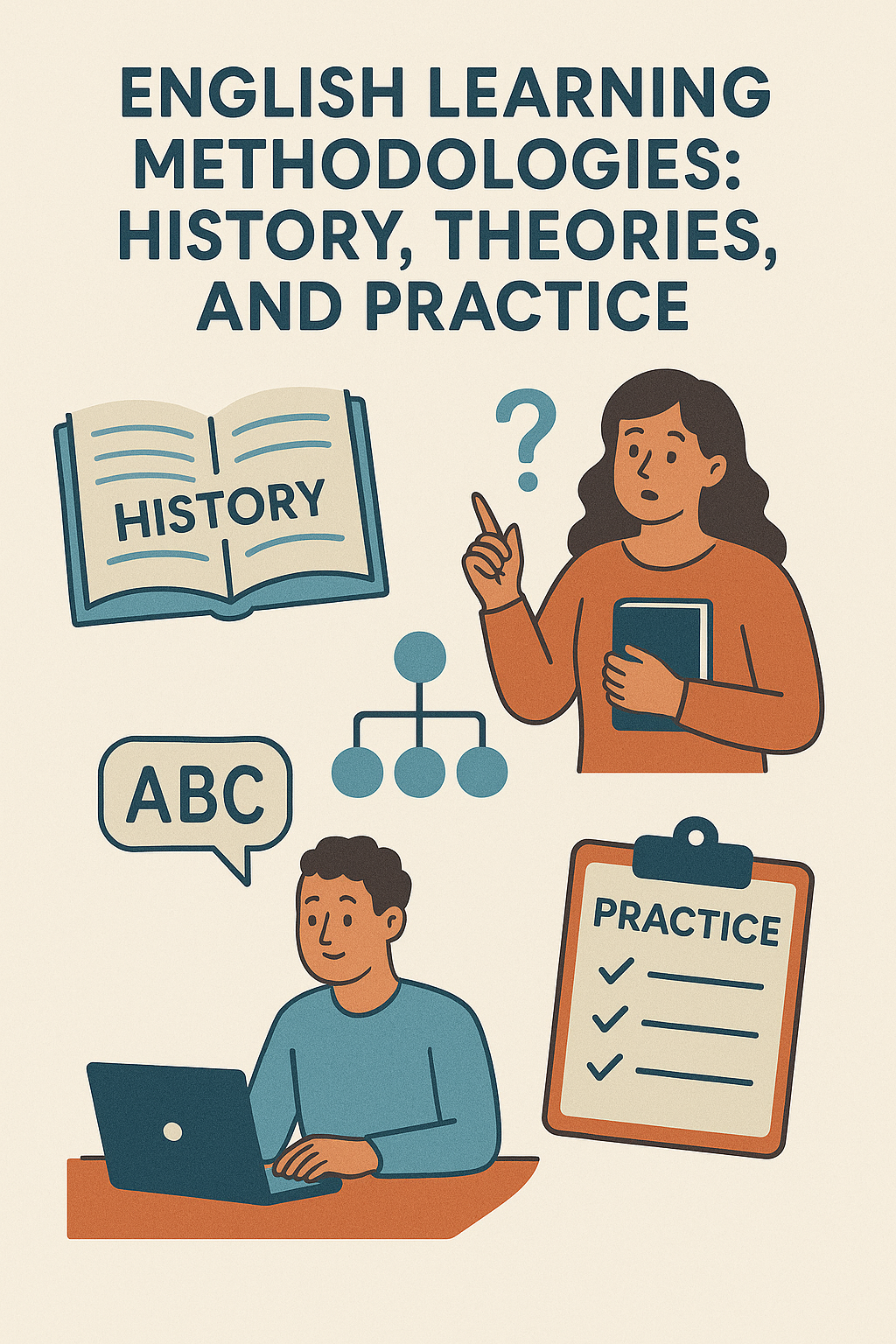
🎓 The Language Beyond Grammar – Part 4
🌿 English Learning Methodologies: History, Theories, and Practice
Language learning has never been a single path —
it’s a long journey shaped by centuries of theories, experiments, and revolutions in education.
From memorizing grammar rules to communicating in real contexts,
each era has reflected a different belief about how humans learn languages.
Let’s explore how these methods evolved, what they emphasize,
and what scholars have said about how English should be learned.
💫 1. Grammar-Translation Method (18th–19th century)
Focus: Reading, writing, grammar rules, and translation between L1 and L2.
This traditional method was dominant in Europe, where language was treated as a system to be studied, not used.
Students translated classical texts and memorized grammatical structures.
Key Assumption: Learning grammar = learning language.
Criticism: It produced accuracy without fluency.
Wilhelm Viëtor (1882): “Language learning must be based on speech, not on written words.”
💡 Legacy: Still influences modern grammar-based curricula in Asia, including Korea.
🌿 2. Direct Method (late 19th – early 20th century)
Focus: Speaking and listening in the target language, no translation.
Developed as a reaction to grammar-translation.
Teachers used real-life situations and everyday vocabulary.
The idea was to imitate the way children learn their first language —
through immersion and repetition.
Key Proponent: Charles Berlitz — founder of the Berlitz schools.
Method: Only English was used in the classroom.
Principle: “Never translate — demonstrate.”
💡 Legacy: Foundation for modern conversation schools and immersion programs.
✨ 3. Audio-Lingual Method (1940s–1960s)
Focus: Listening and speaking through repetition, drills, and pattern practice.
Born from behaviorism (B.F. Skinner, Verbal Behavior, 1957)
and the idea that language learning is habit formation.
Students repeated dialogues and practiced correct responses.
Key Techniques: Repetition, substitution drills, mimicry.
Goal: Automatic speech habits.
“Language learning is a process of mechanical habit formation.” – Skinner
💡 Criticism: Produced parrots, not thinkers — accuracy without creativity.
🪶 4. Cognitive Approach (1960s–1970s)
Focus: Language as a mental process, not just behavior.
With Noam Chomsky’s Universal Grammar theory (1959),
the human mind was seen as innately equipped for language.
Learning shifted from “stimulus-response” to understanding and internalization.
“Language is not learned by habit, but by rule formation.” – Chomsky
💡 Legacy: Paved the way for modern communicative and task-based approaches.
📘 5. Communicative Language Teaching (CLT) (1970s–present)
Focus: Real communication, meaning negotiation, and interaction.
Emerging from Dell Hymes’s idea of “communicative competence,”
this approach views grammar as a tool for expression, not an end in itself.
Key Scholars: Dell Hymes, Michael Halliday, Canale & Swain.
Principle: The goal is to use language appropriately in context.
“Knowing a language means being able to communicate meaningfully.” – Hymes
💡 Legacy: Most widely used modern framework — includes task-based learning, content-based learning, and blended learning.
💻 6. Post-Communicative & Technology-Enhanced Approaches (2000s–present)
Focus: Learner autonomy, collaboration, and digital tools.
Influenced by constructivist theories (Vygotsky, Bruner)
and AI-assisted learning environments (ChatGPT, adaptive systems).
Modern English education emphasizes self-directed learning,
peer collaboration, and emotional engagement.
“Learning is not transmission, but co-construction of meaning.” – Vygotsky
💡 Examples: Online conversation platforms, blended classrooms, project-based learning, AI feedback systems.
🌷 7. Integrative View – The Future of English Learning
Today, most scholars agree that there is no single perfect method.
Effective learning depends on context, motivation, and balance between structure and freedom.
Modern English education blends:
- Grammar for foundation
- Communication for fluency
- Technology for accessibility
- Emotion for sustainability
“The best method is the one that touches both the mind and the heart.” 🌿
🌼 Closing Thought
From the chalkboard to AI chatbots,
English education has evolved from memorization to communication,
from repetition to reflection,
and from instruction to interaction.
Yet, the essence remains the same:
to connect, to express, and to understand each other — beyond words.
“The goal of learning English is not perfection, but connection.” 💫
© MisoEnglish / Michelle Kim. This is original content written by the author. Unauthorized reproduction or full reposting is prohibited. You may quote short parts only with clear credit and a link to the original post.
이 글은 작성자가 직접 집필한 오리지널 콘텐츠입니다. 전체 복제·무단 재게시를 금하며, 일부 인용 시에는 반드시 출처(MisoEnglish)와 링크를 남겨 주세요.
'The Language Beyond Grammar' 카테고리의 다른 글
| The Psychology of Language Learning: The Mind Behind the Words (0) | 2025.11.04 |
|---|---|
| 영어 학습 방법론: 역사, 이론, 그리고 실제 (0) | 2025.11.04 |
| 영어 교육학: 언어 교육의 예술과 과학 (0) | 2025.11.04 |
| The Art and Science of English Language Education (0) | 2025.11.04 |
| 비유적 표현 (Figurative Speech): 단어가 말하는 것 이상의 의미 (0) | 2025.11.04 |


